Sumera B Reshi Existence
Article 35 A empowers the state legislature to define ‘permanent residents’ of the state, their special rights and privileges. This provision was added to the constitution through a presidential order of 1954 with the concurrence of the state government of the day.
Now a day’s Article 35 A has become a hot topic in Kashmir and rest of the world, rather a special recipe for Indian media. Since Article 35 A was challenged by an NGO called “We the Citizens”, Kashmir has been on the boil.
Unlike in past when the separatists in Kashmir would go on front foot to take on Government of India this time it was something different to see.
‘We the Citizens’ a Delhi based NGO questioned Article 35 A, whether their challenge was reasonable or not but it brought another misery for the people of Kashmir. A vale which was famous for its scenic beauty and peace is a blazing paradise where vested interests try to make something out from this boiling pot to their own benefit.
Meanwhile, the hearing which was scheduled for 27 August differed for 31st August and subsequently for four months after state government filed the petition in view of upcoming local body and Panchayat elections in state.
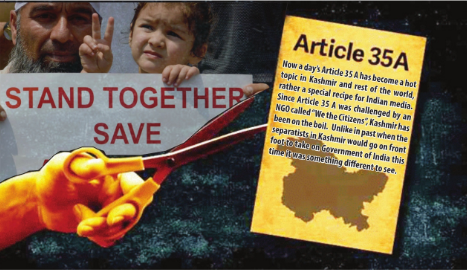
The Youth printed pamphlets which read “SafeGuard Article 35 A”. Two days ahead of the hearing date, local vendors, bus drivers, collegiate and fruit sellers were circulating the pamphlets and bus drivers were directed to paste the pamphlets at the front window pane so that the text is visible to all.
Surely these disseminators of information regarding Article 35 A were not instigated by Hurriyat (M or G). These were commoners who felt their identity is at the stake which Indian state often negates.
India repeatedly says Kashmir has been granted a special provision under Article 370 but in Kashmir people claim that they have aligned with them on three areas – defence, foreign affairs and communication and rest is baseless with no legal standing. Article 370 reflects partial accession with India which Dr Karan Sing has repeatedly mentioned boldly, clearly and openly in the parliament and in media.
So what exactly is Article 35 – A and why this provision took the Kashmiris at ransom? The Delhi agreement between Jawaharlal Nehru and Sheik Abdullah in 1952 led to several additional provisions of the Constitution being extended to the state.
This was done via a presidential order of 1954. Article 35A was inserted then. Article 35A provides the right to purchase and own property, seek government jobs, aid, college admissions and scholarships in the state to the state subject holders only.
However, people who question the existence of Article 35 A argues that those who emigrated from the state to Pakistan during Partition are considered state subjects for two generations, but those who migrated from other than POK and settled in J&K, post Partition, are ineligible. Here they feel the Article 35 A is a gross human rights violation.
Local political parties like the People’s Democratic Party (PDP), and the National Conference (NC), both are averse to its removal. Ex-CM Mehbooba Mufti stated that if the status of J&K is tampered with, there would be no one to hold the Indian flag in the state, while Farooq Abdullah warned of mass protests.
Undoubtedly this could be termed as a political rhetoric. Mufti is more of a catalyst for BJP’s Hindutva agenda rather than empathizers for miserable people of Kashmir.
The debate on Article 35 A lead to another chaotic phase in Kashmir. In 2014, an NGO, We the Citizens, filed a petition seeking the abrogation of Article 370. The J&K government in its affidavit sought dismissal of the petition, however, the central government hasn’t.
The petition was taken to the Supreme Court of India which stated that it is not permanent and Parliament can take a call on scrapping it. Hence, the battle has now shifted to Article 35A, which experts believe could be a precursor to Article 370.
Article 35A was specifically devised to grant protection to the state subject laws that had already been defined under the Maharaja’s rule and notified in 1927 and 1932.
Ahead of hearing day, every face looked insipid, worried and adrift. From a white collar to blue and pink collar professional all were curious and willing to defend Article 35 A. “We must defend Article 35 A at any cost, else we will be sold again to outsiders and shall lose our sanctity”, said a bearded man in his mid-twenties.
“I am disseminating these pamphlets because that is my duty and at least to let people know of the BJP’s great game plan. Besides, I want my people to know the importance of Article 35 A,” said a union leader of bus drivers at Elahibagh. While expressing his views, there was a strange fear but a firm commitment in his eyes.
The sentiments were high on 26 August when news about a fresh petition filed by some other organization spread. Srinagar looked like a ghost city as if zombies had cleaned it from its populace. Silent as death.
“We won’t let India touch Article 35 A. We are aware of the plans they have since it occupied Kashmir. We won’t let any outsider hold Kashmiri citizenship in the name of human right which India herself is unaware of,” expressed a group of youth with an aura of bitterness.
The interaction with them revealed some of the facts which I didn’t know. Since Article 35 A empowers the State Legislature to define permanent residents and this Presidential Order has an exclusive application to J&K. Therefore, striking it down will have implications for other constitutional amendments contained in the 1954 Presidential Order.
The state of Jammu & Kashmir is not the only state which has Article 35 A. Himachal Pradesh and Uttarakhand have laws which don’t permit outsiders to buy land.
Why doesn’t an NGO “We the Citizens” peep into Himachal and Uttarakhand? Why only Jammu & Kashmir? It is because with J& K every mainstream party particularly the BJP takes political mileage or to win the sympathies of Indian electorate.
Why India and its people forget that the accession of J&K with India was conditional to their being given their rights, their sovereignty with regard to matters concerning land and settlement are preserved.
Therefore, Article 35 A cannot be challenged on the ground that it violates fundamental rights or the basic structure of the Constitution because it is pursuant to an original part of the Constitution and pursuant to the limited accession signed with J&K.
Prashant Bhushan, an advocate in the Supreme Court of India wrote in an article titled “Should Article 35 – A be scrapped?” that “Kashmir never acceded fully to India.
Therefore, it is a quasi-sovereign State. It is not like any other State. Article 35 – A follows the Instrument of Accession and the guarantee given to the State of J&K that the State’s autonomy will not be disturbed even by the Constitution”.
Despite knowing the facts, vested interests in India want to repeal Article 35 A by arguing that this law is a discrimination against women. Nonetheless, it is the decision of the state government to review and then take a decision on the law.