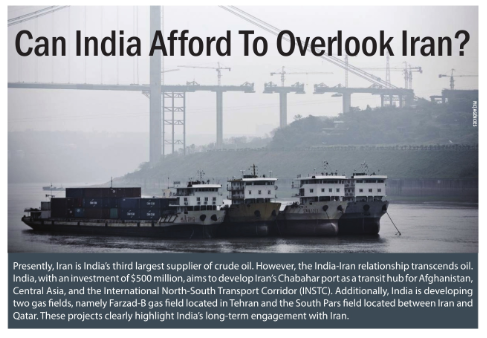
Presently, Iran is India’s third largest supplier of crude oil. However, the India-Iran relationship transcends oil. India, with an investment of $500 million, aims to develop Iran’s Chabahar port as a transit hub for Afghanistan, Central Asia, and the International North-South Transport Corridor (INSTC). Additionally, India is developing two gas fields, namely Farzad-B gas field located in Tehran and the South Pars field located between Iran and Qatar. These projects clearly highlight India’s long-term engagement with Iran.
Sumera B Reshi
Henry A. Kissinger once wrote, “Who controls the food supply controls the people; who control energy can control the whole continents; who controls the money can control the world.” Kissinger that time did not know that this quote is apt for the US and the latest US sanctions on Iran proves it.
To ascertain that the US still rules the roast, Donald Trump announced fresh sanctions on Iran that it lifted just two years ago. The US withdrew from the multilateral deal, known as the Joint Comprehensive Plan of Action (JCPOA), for what is says ‘disastrous flaws’.
This move, thus, left everyone pondering what is cooking up for Iran and the rest of the world – which is hungry for energy. Globally politicians and experts have been focusing on the sanctions on Iran’s vast oil and gas reserves that will be re-imposed in November.
The first wave of sanctions has already hit Iran’s vulnerable economy harder than most are currently anticipating. Economic sanctions on the Islamic Republic could not only cripple the domestic economy but would hand an advantage to the US regional ally Saudi Arabia, which is the third largest producer of crude oil.
A portion of sanctions has been imposed since August 6, while those pertaining to the oil industry will be applicable from November 4, which will restrict sales of oil and petrochemical products from Iran. Washington’s aim is to cut off oil exports and thus reduce the financial power of Tehran.
President Trump’s decision has rippling effects around the world. It will also have a collateral effect on India which has made a huge investment in the development of Chabahar port and Farzad B gas oil fields in Iran. India is the third largest importer of crude oil from Iran and meets 15 per cent of India’s domestic oil requirement. The second round of sanctions scheduled in November this year according to experts is seen as the biggest disruptive force with oil market analyst predicting that Iran’s daily production could fall by 1.5 million barrels a day.
This time, the US is adamant in its stance. As per a senior US State Department official, there will be no concession for allies who engage in trade with Iran. The official further said that all buyers of Iranian crude, including India, should cut all currency outflows to the country in the form of oil imports by 4 November 2018. Also, the Trump administration has so far rejected requests by foreign governments and companies that would allow them to continue to conduct business with Iran. Europe and India are in a fiddly situation due to sanctions on Iran.
European signatories of the JCPOA have thus prepared a package of economic measures to try to rescue the deal. Additionally, EU members of the JCPOA has activated a law to protect EU companies doing legitimate business with Iran from the impact of US extra-territorial sanctions.
Implications of Sanctions on Iran & the Oil Market
Oil market analysts and estimates reveal that Iran’s oil exports which are valued at $36 billion in 2016, could drop by up to two-thirds this year with the reinstatement of sanctions. That could have ripples beyond Iran as global oil markets cope with supply strains.
It is also estimated that the U.S. aircraft manufacturer Boeing and European corporation Airbus are set to lose contracts worth $39 billion. In 2017, the overall value of EU trade with Iran was about $23 billion, with three-quarters of it related to energy deals.
Due to the first round of sanctions and another one in offing, inflation has tripled in Iran.
There have been huge street protests in Iran over deteriorating economic conditions and charges of corruption and mismanagement. Protesters have targeted the government of President Hassan Rouhani, who championed the nuclear deal as a way of boosting the economy, as well as more hard-line parts of the regime, such as Supreme Leader Ali Khamenei, who has criticized the JCPOA.
In case EU members to the JCPOA are unable to carry out the business with Iran, then Iranian leaders are expected to walk away from the deal.
Iran has been described as the ‘Germany of the Middle East’, a major emerging market to open fully to the outside world, with more than 80 million consumers, a highly educated population and an array of natural resources — including precious metals. Nevertheless, the breakdown of the Iranian Rial since Trump’s decision to pull out of the nuclear deal is an economic indicator of the disturbance ahead.
Undoubtedly, Iran has a large consumer market, it is a formidable industrial player in the Middle East and North Africa – a market with more than 300 million consumers and as huge as the population of the US. And surely the current spate of sanctions are designed to hit Iran’s steel, aluminium and auto sectors by limiting access to raw materials and essential parts.
Two years ago (2015) when the sanctions were lifted, Iran’s economy expanded by 12.5 per cent and carried on with solid growth in 2016. Market analysts call it a post-sanctions boost. In an interview with CNN in May this year, Joe Kaeser, the CEO of German industrial conglomerate Siemens said that the company would stop all new deals in Iran owing to the current US sanctions.
Experts, however, believe that the US wants to drive a wedge between Iran’s leadership and the Iranian people with the cardinal aim of regime change, which it did in Iraq however, the US has been denying the allegations. Certainly, due to fresh sanctions, Iranian Rial bucked further, thus, wreaked havoc on an average Iranian.
The situations since May this year has shot up unemployment, especially among the youth, inflation has spiralled higher due to the cost of imported goods. Moreover, there have been water and power shortages because of the country lack infrastructure and due to on & off sanctions. The economic turbulence and uncertainty have led to sporadic protests throughout Iran.
Though the Supreme Leader, Ayatollah Ali Khamenei since then has tried to balance the power of the perceived moderates in government and a hardline military apparatus, President Hassan Rouhani will probably continue to take the public pressure. However, politicians and bureaucrats will try to work on the ‘continuation of Iran’s exports of oil and gas’, but this time they have to deal with companies, not governments that buy Iran’s oil. Therefore, Iran is facing a threat of exclusion from the US market and banking system which is enough to stop them buying it, international shipping companies from moving it and insurers from covering that trade.
The biggest shock came when Iran’s biggest market in Asia, South Korea stopped buying both crude and condensate since late June. This is critical, because the Koreans are the top buyers of its condensate, accounting for more than 50 per cent of shipments over the 12 months through June.
Owing to the harsh sanctions, there will be possible energy crisis world over. President Trump has acknowledged this risk in a recent tweet where he implies that Saudi Arabia is able and willing to further increase production to two million barrels. Analysts, however, strongly doubt whether Riyadh is able to raise production by this amount. In response, Riyadh, however, did not confirm Trump’s request but affirmed the Kingdom’s capacity to discreetly use its spare capacity to balance the world’s markets.
Furthermore, fears are looming large that if Iran fails to export oil, which is a backbone of its economy, West Asia might plunge into crisis. Despite firm stance by the US, politicians and governments are trying to talk to their US counterparts and if the companies don’t receive waivers, imports could fall to zero before November. The current energy crisis might leave India and China in jeopardy. None of the countries has cut purchases yet. Until India gets a waiver from the US, Hindustan Petroleum Corp. is unlikely to buy more Iranian oil.
However, at 3.1 million tonnes shipped, the quantity of oil imported from Iraq is greater than the 2.8 million tonnes imported from Saudi Arabia. Iraq overtook Saudi Arabia as India’s largest supplier of crude by volume in December 2017 on account of discounted sales.
The price per tonne for crude from Iraq and Saudi Arabia were $453 and $494 respectively. Iran currently accounts for 16.91 per cent of India’s total crude oil imports by volume.
Economic growth, coupled with low prices had led to an increase in demand for oil in the past few years. The import value of crude increased from 171.73 million metric tonnes in 2012 to 213.93 million metric tonnes in 2017. The Ministry of Petroleum and Natural Gas estimates this figure will touch 217.08 million metric tonnes in 2018.
Earlier, India had devised a system to buy oil by partially bartering goods and remitting payment in rupees and now the government is looking to revive its quasi-barter mechanism of trade with Iran to sidestep the US sanctions.
Since the sanctions on oil and petrochemicals, there will be a hike in oil prices world over, it is unclear which way shall India go to meet its demands? India can neither ire the US nor break trade links with Iran. India is caught in a quandary because it can’t hike domestic oil prices and irk its populace. At present, India can’t buy oil elsewhere because that could be expensive to cut out purchases from Iran.
To avoid growing oil crisis, some argue that India could import oil from the US, which would serve several purposes at once. It could provide India with an alternative source of oil; it would also cut the US trade deficit with India, and help create goodwill with the Trump administration that is set to intensify its trade war with rivals and allies alike.
Yet these are all hypothetical models until India chooses one. According to Sanjiv Singh, Chairman Indian Oil Corp., Saudi Arabia alone has the capacity to cover the oil shortfall if Iran’s oil exports dry up. “We have Plan A, B, C & D. We are fully prepared,” he said.
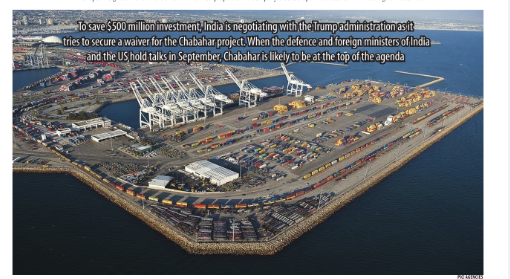
However, to save $500 million investment, India is negotiating with the Trump administration as it tries to secure a waiver for the Chabahar project. When the defence and foreign ministers of India and the US hold talks in September, Chabahar is likely to be at the top of the agenda.
Dhruva Jaishankar, a foreign policy expert at the Brookings Institute India, suggested the effects of any US sanctions could be absorbed by India. The terms of the project could yet be renegotiated and India could explore alternative arrangements, such as an improved air freight corridor, to cushion the effect.
“So, while India will feel the effects, they may not be as significant as some feared,” Jaishankar said.
The acquaintance between India and Iran is not new; both shared common borders until the partition of the subcontinent in 1947. Presently, Iran is India’s third largest supplier of crude oil.
However, the India-Iran relationship transcends oil. India, with an investment of $500 million, aims to develop Iran’s Chabahar port as a transit hub for Afghanistan, Central Asia, and the International North-South Transport Corridor (INSTC). Additionally, India is developing two gas fields, namely Farzad-B gas field located in Tehran and the South Pars field located between Iran and Qatar. These projects clearly highlight India’s long-term engagement with Iran.
Furthermore, Chabahar presents an opportunity for India and Iran to align their bilateral ties beyond the oil trade. Undeniably, the new sanctions will place pressure on the India-Iran oil trade, underlining the significance of the Chabahar project as it will become a major point – perhaps the only point – of cooperation between the two countries.
Nonetheless, the US sanctions would severely stupefy these projects and investments.
More than 80 per cent of India’s oil is imported through foreign tankers, thereby making India’s energy security conditional upon the US sanctions. Also, the sanctions would impact investments in Chabahar as well as Farzad and South Pars oil field.
Foreign companies and even Indian multinational companies with operations in the United States or dependent on the US financial system are planning to withdraw operations from Iran with the advent of sanctions.
The State Bank of India has already announced it will suspend payment operations in Iran from November 2018. Reliance Industries Limited (RIL) also has decided to halt its oil imports from Iran.
The miseries for India don’t end here. There is more at stake for India than its relationship to Washington. Besides oil, there is a have a huge Indian diasporas in Saudi Arabia and the UAE and are also the largest source of remittances (accounting for approximately 36 per cent of total India receives). There have been already attempts by Saudi Arabia and UAE to entice India. Companies like Saudi Aramco and Abu Dhabi National Company (ADNOC) have promised to invest $44 billion — roughly amounting to a 50 per cent stake — in Ratnagiri Refinery and Petrochemical Limited (RRPCL).
Moreover, India has to be very careful because it has to pay attention to the Chinese dimension as well. The US sanctions would force Iran to drift sharply toward non-Western powers like Russia and more so toward China. Despite harsh US sanctions and strict directions for the countries which buy Iranian oil, China hasn’t nor has any intentions to curtail ties with Iran. China calls the China – Iran relationship as ’20 centuries of cooperation’.
Further, Iran plays a crucial role in China’s Belt and Road Initiative (BRI). Market analysts believe that there is a possibility of a petrol yuan emerging, with China using its renminbi in a transaction with Iran which is an important step towards the internationalization of the Chinese currency.
Experts also opine that Iran – China engagement will weaken the impact of the US sanctions and Beijing on the higher ground. Owing to this new equation, India has to play safe.
These fresh sanction imposed on Iran doesn’t concern India only rather Afghanistan’s interests could also be vulnerable in the event of cancellations or delays. The port will provide Afghanistan with vital direct sea access, which the country hopes will improve its trade prospects.
Remarkably, exporting goods to countries such as India will allow Afghanistan to reduce its dependence on Pakistan.
While India has to keep an eye on Iran – China alliance, it also has to meet its domestic oil demands without putting much pressure on its populace. For that reason, India has to argue for a waiver regarding oil trade and critical projects like Chabahar port.
In case India is forced to withdraw from Iranian oil, this will lead to an overall price hike and could push Modi government to the periphery. This time neither India nor Modi can afford a price hike because that could be detrimental for both.