Few empowered Kashmiri women take on themselves to break barriers, taboos surrounding menstruation and menstrual hygiene. These game changers bring about real behavioral change in women Kashmiri Girls
Shabir Ahmad
Srinagar:
And in absence of proper education and knowledge about this issue, many women and girls are happily continuing the practice of using cloth during periods having no idea that it may lead to high risk ailments. The studies too have shown that many girls during their first period feel they have been afflicted by some terrible disease. Also 70% of Indian women don’t have access to appropriate menstrual hygiene products, and thus use sand, ash and rags. As many as 23 % girls in India drop out of school when they start menstruating, and 20% women don’t use latrines during menstruation due to cultural taboos.
The socially and culturally conservative Kashmir is not much different. In many urban areas and in overwhelming rural pockets of Kashmir, awareness about menstrual health and hygiene is abysmally low. But now things seem to be changing for good, as some young women – professionals, civil servants and entrepreneurs – have taken it upon themselves to break taboos about menstruation and bring about a behavioural change among women through awareness and counselling. Such bright women are game changers in Kashmir’s menstrual health landscape.
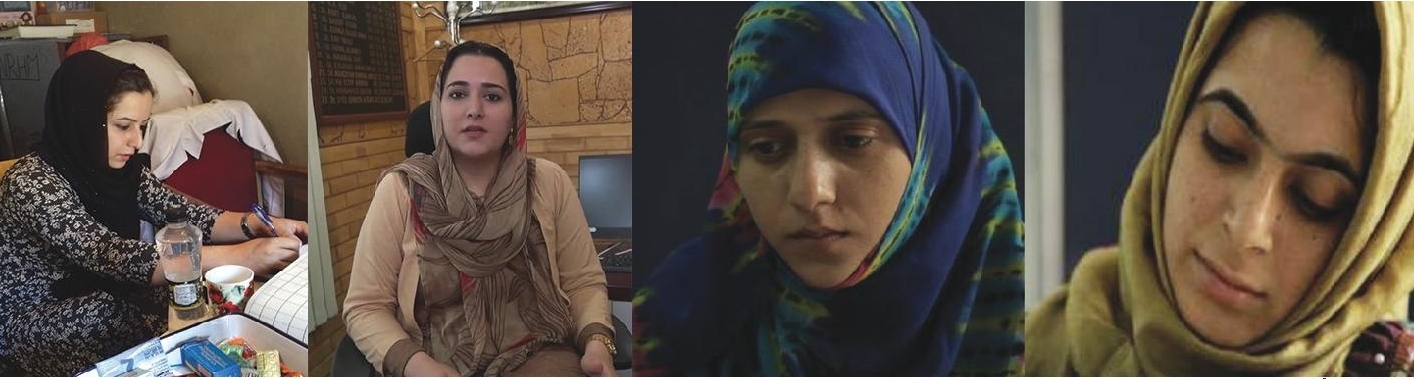
31-year-old Dr Auqfeen Nisar, a post graduate student of community medicine, is making a huge difference through her honest approach in dealing with taboos and ignorance around menstrual health and hygiene.
Every Wednesday, she visits a health centre at one of Srinagar’s poor locality to monitor immunization session, and simultaneously conduct Out Patient Department (OPD). Here she conducts awareness and counselling sessions with the women and girls of the community on menstrual health and hygiene. So every week, as Dr Auqfeen sets on for this session, dozens of women would huddle around her and talk about menstruation and menstrual hygiene – a subject which till recently was a ‘not-talkable’ subject for most of the women because of cultural taboos associated with. Now, in presence of Dr Auqfeen, they talk openly and confidently about this subject, get awareness about maintaining hygiene and ensure that no women sticks to the traditional methods of using cloth or rags during menses. Dr Auqfeen distributes sanitary napkins, almost free, to women, and lectures them on the important of changing the napkins after every four or six hours to avoid diseases.
When did this young doctor decide to do something for these women? It was during her weekly OPD at Government Health Centre, Zaldar-Mohalla Saidakadal, run by Department of Social and Preventive Medicine, Government Medical College Srinagar, that Dr Auqfeen’s attention was grabbed by this grave concern. She was shocked to find out that adolescent girls were using cloth during their periods because they were fed with the notion that sanitary pads lead to infertility. “Most of the adolescent girls in the locality were following their mothers and using cloth. With the result, the girls suffered from different reproductive tract infections,” she said.
Pained by the poor hygiene, social taboos and lack of affordability, Dr Auqfeen Nisar, who is pursuing MD in Community Medicine at Government Medical College, Srinagar, started the crowd funding project to provide sanitary pads to the impoverished girls and combat the related infections. Named as ‘Panen Fiker’ (let’s take care of ourselves), the project, as per Dr Auqfeen, is actually a social marketing to enhance the use of sanitary pads among the adolescent girls.
“I started a post on the social media for donations. I also conducted an awareness session in the neighbourhood and sought their support. People are not well off but they can contribute Rs 10 or 20 or maximum 50. The maximum contribution has been from my department”, she said.
After careful analysis, she decided to provide the sanitary pads on subsidized rates so that girls can start using it. “Once you provide pads free of cost and then stop it, they will not use it. So I want to provide pads on subsidized rates. I purchased sanitary pads and donated it among the girls”, she said.
The project is gaining support by the day with NGOs coming forward with the offer of help. “I have also registered on an online funding portal and have decided to start my website where I can seek the support of the people for the project. One NGO came forward with help. They also wanted to expand this project and conduct awareness sessions in other areas as well,” said Dr Auqfeen.
The women and girls benefited from Dr Auqfeen’s initiative and all are happy to have received the necessary knowledge about menstrual health.
“We live in city, but our awareness regarding menstrual health and hygiene was worse than what can be expected of a village lady,” said Urfi Jan, a teenage girl of Zaldar mohalla Saidakadal.
“Because of Dr Auqfeen’s efforts, we now know how to take care of ourselves during periods by ensuring cleanliness and hygiene. We are being provided sanitary napkins, almost free. It has helped all those who can’t afford sanitary pads of their own. I feel emancipated and don’t shy anymore in discussing menstruation with parents and peers,” she added.
Yasmeena, a married woman, said that she now uses sanitary pads during menses and stopped old practice of using cloth.
“I was given this notion by my mother that we can’t work during periods and have to take only rest, or we can’t take a bath or eat this or that food. Now we are fully aware about do’s and dont’s during periods. We have stopped using cloth and use only sanitary pads now,” she said.
A kind of reflective initiative to that of Dr Auqfeen’s was started by two young social entrepreneurs in a border village of Jammu and Kashmir. Mir Musharraf, 18, and Mubeena Khan, 25, who grew up in an orphanage in Kashmir, began their entrepreneurial journey two years ago, knowing well the arduous task they had chosen for themselves.
“We have experienced what women in Kashmir, particularly in the border and rural areas go through during their periods. It’s not only about the stigma; it is also about hygiene during periods,” news agency IANS quoted Mir as saying.
“It was never going to be easy, we knew that. Talking about menstruating is not easy even with women in Kashmir. But we wanted to defeat the stigma.”
Mir, who originally hails from Keran village some 100 km north of state capital Srinagar, lost her father, a farmer, to blood cancer when she was still young. Keran, the last village of the eponymous border sector on the Line of Control (LoC) that divides Jammu and Kashmir between India and Pakistan, has often faced the brunt of military skirmishes between the armies of the two countries.
Infact, growing up in a society that stigmatizes menstruation, battling the taboos attached to what is a routine biological process is not an easy task. Mir and Khan are not only creating awareness but also manufacturing and selling sanitary napkins to help poor women who cannot afford branded products.
Experts say that the importance of menstrual health and hygiene still needs to be propagated to a large section of woman population in the country. The message that it’s okay to talk about menstruation and menstrual health needs to be reiterated continuously and consistently.
“It is normal physiological process, so there is no need for women and girls of this age to feel ashamed of this or hide it. Our society, particularly parents and teachers should take lead and encourage girls and women to speak about it. When our religion (Islam) allows us to talk about this, why should we stigmatize menstruation or associate taboos with it,” said Dr Saleem Khan, head of Social and Preventive Medicine Department, GMC Srinagar. He said that his department is working hard to spread awareness about menstrual health and hygiene, but “more needs to be done”.
“The awareness about menstrual health and hygiene is very low in our women, particularly among poor section of the society. Need of the hour is to run and sustained campaign by involving schools, anganwadi centers, community leaders, and obviously media,” Dr Saleem maintained.
Syed Sehrish Asgar, an IAS officer and Deputy Commissioner of Budgam, actually did the same. She has taken up the initiative to create awareness on menstruation among young girls who are stressed about the isolation they go through when they are on their period.
“The importance of menstrual health and hygiene still needs to be propagated to a large section of woman population in the country. The message that it’s okay to talk about menstruation and menstrual health needs to be reiterated continuously and consistently,” she was quoted in media as saying.
Witnessing the lack of basic facilities like clean toilets in her district and almost 300 girls dropping out of 1,200 schools, Asgar took the matter into her own hands. She ordered that sanitary napkin dispensers and incinerators to be installed in the premises of all Higher Secondary Girls’ schools and colleges in her district and also in Srinagar.
“All the incinerators and sanitary napkins dispensers will be placed at 106 higher secondary schools, five-degree colleges, and one ITI in the district. Also, sanitary napkin dispensers will be placed at the DC’s office as well as in the Srinagar international airport that falls in the district,” she said.
The lady IAS officer’s endeavor will definitely create a safe environment for young girls. “We have to try and create a society where women are concerned about their health and hygiene and do not feel ashamed of it. It’s their right to live with dignity, and the stigma around menstruation needs to be addressed,” she said to press.
Menstrual Hygiene Day (MH Day) is being organized on May 28 to raise awareness of the challenges women and girls worldwide face due to their menstruation and to highlight solutions that address these challenges.
MH Day is a global platform that brings together non-government organizations, government agencies, private sector, media and individuals to promote menstrual hygiene management (MHM). MH day was initiated by WASH United in 2013 and on 28 May 2014 it was celebrated for the first time.
Ministry of Health and Family Welfare, Government of India too launched a menstrual hygiene scheme for promotion of menstrual hygiene among adolescent girls (10-19 years) in rural areas of selected districts in 2011. From 2014 onwards scheme was extended to all districts under Rashtriya Kishore Swasthya Karyakram to enhance MH knowledge, improve hygiene practices, provide subsidised sanitary absorbents, and raise awareness of MHM at school.
Meanwhile, the state government is also ensuring that adolescent girls must have adequate knowledge and information about menstrual hygiene and the use of sanitary napkins, that high quality, safe products are made available to them, and environmentally safe disposal mechanisms are readily accessible.
The National Health Mission (NHM) under Rashtriya Kishore Swasthya Karyakram (RKSK) will distribute sanitary napkins to rural adolescent girls at the subsidized rates of Rs 6 per pack.
The sanitary napkins will be provided under Menstrual Hygiene Scheme to rural adolescent girls of the age group of 10 to 19 years in 10 districts Rajouri, Poonch, Doda, Kishtwar, Ramban, Udhampur, Kathua Baramulla, Bandipora and Kupwara of the State. Sanitary napkins will be available through ASHA workers of the concerned blocks of the districts.
The NHM has approached Union Ministry of Health & Family Welfare for extension of this scheme to rest of the 12 districts of the State.