Handicraft dept’s skill oriented courses are flawed in the sense that it lacks the vision of ensuring economic guarantee to trainees Skilled
Asem Mohiuddin
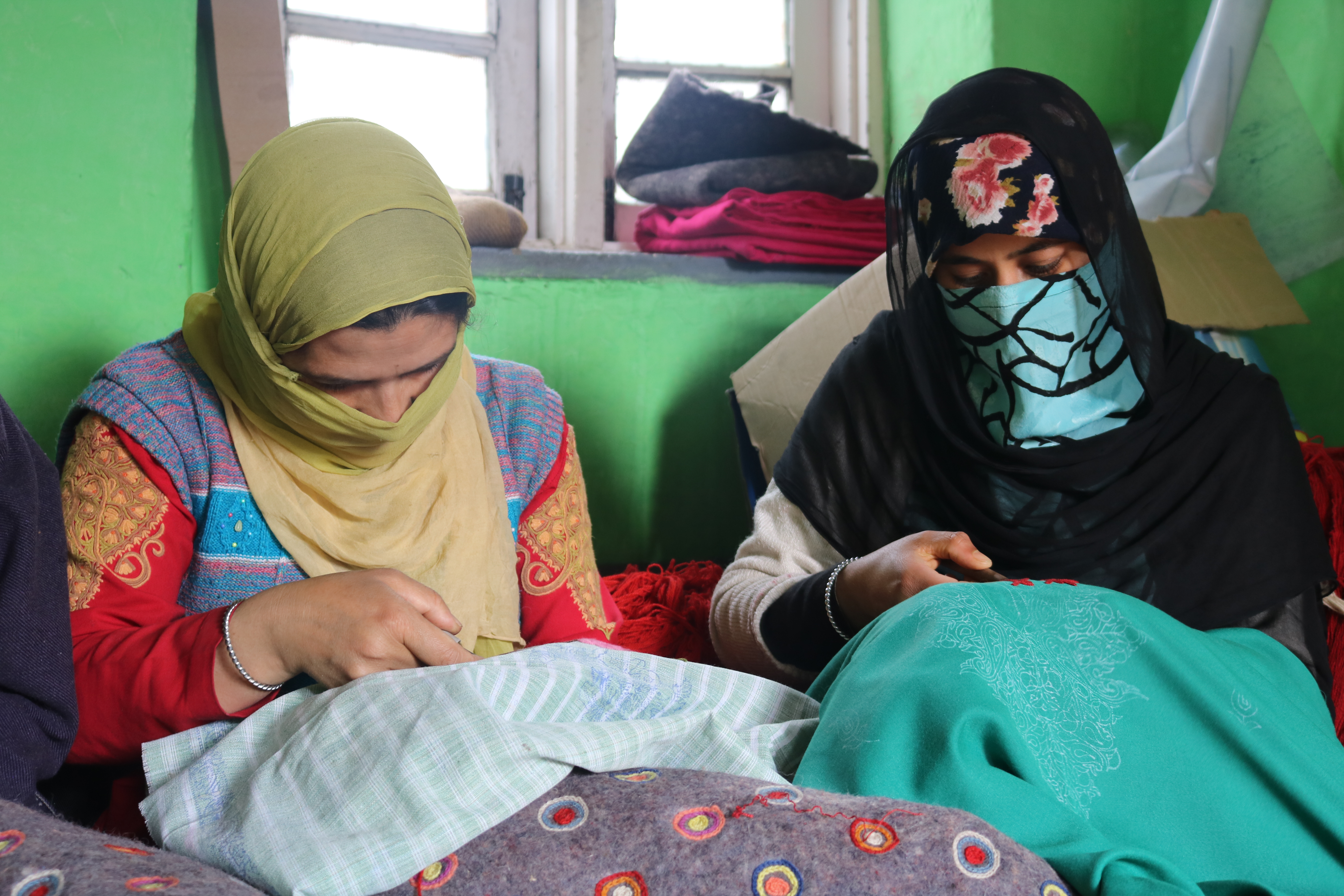
Srinagar:In a modest single story house situated on the foothills of lush green mountains in Kanispora village of Baramulla district, 20-year old Iram Mushtaq is busy in stitching a shawl with embroidery. The 20 year old girl has to deliver the product to a costumer in a week’s time. This pretty chubby girl is a school dropout, as she had no interests in the conventional educational system.
“I was never interested in the formal education process. I always wanted to do something skill oriented,” Iram says.
Iram was one among 50 girls trained in shawal embroidery for a year by trainers of handicrafts department in the village community centre. The village is boastfully about having over 50 skilled trained girls in shawl embroidery. Over expectations from the training process to become financially independent eventually shattered the dreams of Iram and other 50 girls.
“We were promised sky during counselling and training of the course. We were told by the concerned officials that we will be economically self sufficient after completion of the training course. We finished training and learned shawl embroidery, but don’t know how to earn,” rues Iram.
Iram’s case is a clear reflection of the flaw in handicraft department’s training process – which although makes the trainees skilled but not ensures their economic guarantee on completion. That means the department has failed in taking their core training activity to the logical conclusion of ensuring economic independence of the trainees. The handicrafts department across the nooks and corner of Kashmir is training thousands of youths in shawl embroidery, carpet weaving, Paper Machie and other related crafts.
Given to its immense economic potential and contributing over Rs 1000 crores annually to India’s global exports, the union Home Minister Amit Shah in his recent visit put the department on priority. He ensured to revive the industry and allow it to thrive to boost the local economy and create more employment opportunities.
Details Of Handicrafts Exports
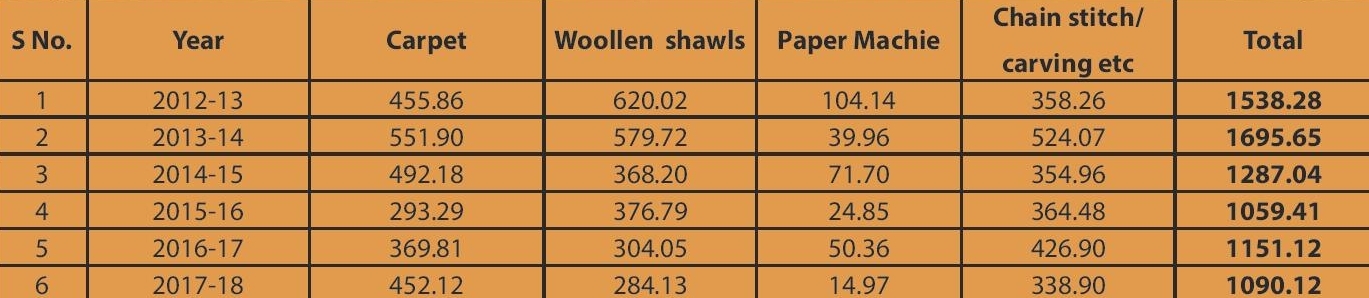
The Handicrafts industry in Kashmir has thrived in the worst ever political situations and sustained its economy. However, the lackadaisical attitude of successive governments not only put the industry into limbo, the thousands of people associated with it have also shifted to other means of livelihood.
The official data reveals that the industry has even refused to succumb to the global economic meltdown in past several years and the ongoing political instability in the Middle East.
“It continues to grow and expand in the virgin markets of Europe and Middle East. It had least impact of ongoing political conflict in middle east and economic crisis in west,” said the senior official of Handicrafts department.
Unfortunately, the successive regimes in the valley have failed to tap the growing economic potential of the sector.
Of the 7 million valley’s populations, there are only 1.85 lakh artisans registered with the concerned department and subsequently associated with the centuries old trade.
“The total number of people associated with this trade and connected to Handicrafts department directly or indirectly are 3.75 Lakh people. Of which 1.85 lakh are registered with us,” the official in the department told The Legitimate.
While this figure seems quite encouraging and offering the employability to good number of people after government jobs and horticulture sector, the experts in the field opine that its potential is not tapped beyond 10 per cent.
As of there are only three districts of central Kashmir predominantly associated with the sector? In North Kashmir, few areas are associated with carpet weaving, so are in south Kashmir.
“The crafts need to be expanded in the nooks and corner of valley. It will significantly address the rising unemployability in Kashmir and will target those who are either illiterate or semi literate. Such people find very difficult to grab jobs in the market,” says Ghulam Hassan, an artisan of Srinagar- associated with the industry for over five decades.
The Karnah town which is over 150 kilometres away from Srinagar city in north Kashmir and remain landlocked for over six months of winters have a huge potential in adopting this trade.
Dr Aliyas, Sub District Magistrate Karnah is of the opinion that introducing Handicrafts in the area on industrial pattern will have extremely positive results to the local economy.
“We have land scarcity here. Agriculture and horticulture have not much scope. But home grown industrial sector that includes craft may serve the economic boom for the area. So this needs to be introduced here since there is no manpower dearth,” he discussed with The Legitimate.
In 1975-76 when Chief Minister Sheikh Mohammad Abdullah aimed to revolutionize the economic sector of Jammu and Kashmir which was physically locked owing to its typical geography and topography, Sheikh ordered to expand the handicrafts activities across the entire region. Under the process as many as 553 training centres were approved and set up in entire state.
The initiative, however since then continues to run in state without making any significant inroads in the peripheries of valley to give flip to the local economy.
The department every year as per its official data trains more than 7000 youths in various trades of handcrafts, of which it claims more than 6000 get register with the department to continue activities of trade in future. This is all what the official figures reveal, something unmatched to the ground reports.
Majority of those trained lack the external exposure and have rarely been to city or government offices, making it difficult for them to register their units; manage raw material and then sell the end product in the market for competitive prices.
The Public Relations Officer to Handicrafts department, Reyaz Ahmad admits that the broker system and agents are significantly exploiting the real manufacturers of the product. They lack direct access to the market to buy raw material and then sell the product to the customers. This is the source of dissatisfaction and de-motivation for majority of artisans who switch over to other trades.
“Given to this scenario we are working on digital technology and build up e-commerce portals where from the artisans could directly sell their products to the customers. We are working on seeking to an end the middlemen’s intervention in the business to ensure the artisans and manufacturers are rightly empowered and transparency is invoked in the system”.
Reyaz said his department organize more than thirty exhibitions around the year where they allow direct meet between the seller and buyer.
“These exhibitions occur in almost all top cities of India and business worth thirty crores annually is realized from the exhibitions that directly go to the seller. Besides, we also have cash rewards for the best artisans and annually over 10 awards are conferred,” he adds.
Kashmir Arts emporium offers a relief for few hundred artisans. This department of government is meant to buy the local handicrafts products from artisans and then sell it to customers across the globe.
Of the 1.75 lakh registered artisans in state, it has only some 600 registered who sell their products to them against competitive prices.
“We are a government department but our job is simple business. We buy products from the local artisans and then sell it to customers at our showrooms located across the top metro cities of India,” says Chief Marketing Officer, at Kashmir Arts Emporium, Mushtaq Ahmad Shah.
Shah, however, says that they buy products at competitive prices from the artisans.
“We have panel of experts who discuss and bargain with the artists when they come along with the products to us. The prices we pay are as per the quality of product,” he adds.
Shah shares many encouraging stories of artisans associated with them.
“If the artist is innovative and creative, he will succeed and earn a lot. We have so many such sellers here.”
The department, unfortunately which could have saved the poor artisan form exploitation of agents and brokers have limited access to the people.
Officials say they have limited mandate and are confined to business part only. Rest training and other empowerment of artisans is the core job of directorate of Handicrafts.
However, joining hands together and establishing the contact would have significantly helped the artisans to have direct access to the market and sell their products at genuine costs.
Most of the artisans, Shah says, registered with them are predominantly from Srinagar and Budgam districts.
Going by the facts revealed by Shah, the handicrafts trade technically is confined to just twin districts of the total 22 in state. This opens a huge scope for the expansion of handicraft in almost all districts of state.