Sumera B. Reshi
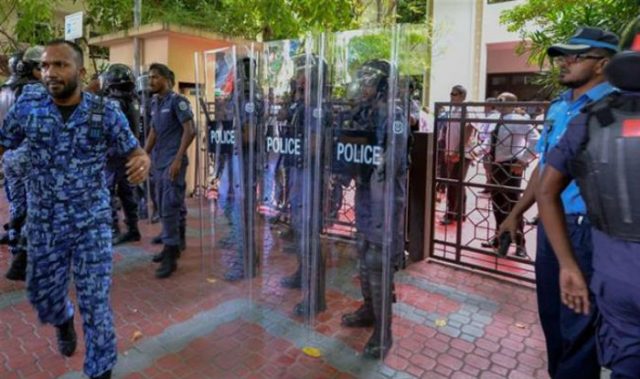 As a political crisis deepens in the Maldives, it appears that heavyweights like China and India are trying to strengthen their grip and vying for strategic dominance in the picturesque Indian Ocean nation.
Former Maldives president Mohamed Nasheed, who was country’s first democratically elected President, had sought India’s military help to resolve the crisis in the island nation, which is placed under a state of emergency. The fast-changing political scene in the Maldives over the past several days has caught India in a quandary. In response to the crisis in the Maldives, the Indian government said it was “disturbed” by the Maldives government’s declaration of a state of emergency and is concerned by the arrests of top judges and opposition leaders. Interpreting the reaction of the Indian government over the political calamity, Maldives announced that it has excluded India from the list of “friendly nations”.
Infuriated with India’s reaction, Maldives announced that its envoy would travel to China, Pakistan and Saudi Arabia, however, it put various reasons to omit its envoy’s travel to India. But it is obvious that the interference by India in the archipelago is the cardinal reason why the Maldives skipped Indian tour. As a matter of fact, both India and China want to be a part of the turmoil that erupted 1st February when the Maldives’ Supreme Court overturned the convictions of several opposition politicians, including the president’s main rival. Both the heavyweights want to demonstrate their muscle power but subtly & stealthily.
The crisis in the Maldives is another display of power in South Asia. China, as well as Saudi Arabia, are trying to gain a foothold in the archipelago just to gain concessions for military bases. For China, Maldives is an important joint to realize its “string of pearls” plan and gain access to the Middle East. On the contrary, Saudi Arabia also wants to gain access to sea route so to reach its regional arch-rival, Iran.
Keeping the making and breaking of strategic alliances in view, it is pertinent to say that the new strategic alliances in South Asia have hardened. Even though the growing new alliances remains informal, the US and India have come closer to each other than ever before. Same holds true for China and Pakistan, their partnership has grown closer in past two decades. The current alliance didn’t bind overnight, their origin dates back to 1962 according to the Diplomat magazine. Since 1962, the alliance has hastened significantly.
Despite the fact that it took decades to make the new strategic alliances, yet it came to the limelight on January 26, 2015. This was the time when President Barak Obama was invited to India as a guest on Republican day and sat next to Prime Minister Narendra Modi. It was Obama’s second tour to India. The visit of President Obama was a clear indication that the US is committed to developing close relations with India. While America was warmer with India, Pakistan was partnering with China. Pakistan’s Chief of Army Staff (COAS), Gen. Raheel Sharif met Chinese leaders in Beijing. Both China and Pakistan announced their alliance was all-weather and taller than the Himalayas.
Meanwhile, the alliances continued growing up closer. Then President Xi Jinping visited Pakistan with $46 billion in investment to build an economic corridor from Western China to the Persian Gulf. As per this economic investment, Xinjiang & Tibet will be linked to Baluchistan.
The corridor will end at Gwadar where Pakistan has planned a new city to rival Dubai and the city is expected to emerge as the trade hub of Asia. The said economic corridor planned by China and implemented by Pakistan promises to transform Pakistan a prosperous country.
In return for this huge investment, Pakistan promised Xi that Pakistan will create a new special division of the Pakistani Army to protect Chinese workers in Pakistan. Pakistan will keep 10,000 troops to protect Chinese people working on CPEC. And China will gain quick and easy access to Africa & Middle East through CPEC. In contrast, Obama promised the US’s backing to India for a permanent seat on the UN Security Council, however, this commitment has certain shades of grey because China has a veto and it won’t allow India an easy entry into the UNSC.
Despite the barricades, America is committed to working on a joint strategic vision for the Asia –Pacific and the Indian Ocean, nonetheless, no such vision existed between the US and Pakistan. Currently and in future, Pakistan will be number two or less for the US. The US – India and China – Pakistan alliance has grown multi fold over the years keeping the paradigm shift in view in the world political scene.
Recently, China, Russia and Pakistan have formed an unofficial alliance to counter America’s global dominance. As a matter of fact, China, Russia and Pakistan axis hasn’t bothered the US much. Washington has a number of allies in Asia including Japan and all of these allies are ready to jump into the fire and die for the US on the battlefield. And in case of any confrontation, the US-India-Japan-Europe will form an alliance to defeat China-Russia-Pakistan alliance.
After the disintegration of the erstwhile USSR, Russia under the leadership of Vladimir Putin strengthened itself. Recently Russia has been actively solidifying its military ties with both China and Pakistan. Moreover, Russia also received a crucial support from China on the most important global issues like Syria. Besides, a major development is that Russia is busy in consolidating its diplomatic and military ties with Pakistan, its one time Cold War rival. And China has been very supportive of not only Russia but also Pakistan. Pakistan, in fact, has always been China’s traditional ally and Beijing has always protected Islamabad against its historical rival India.
Political pundits believe that the US is particularly weak at present. The Donald Trump vs Hillary Clinton polls indicates that the country has never been so divided before and it makes it look weak from the outside. While Russian president Vladimir Putin has the distinction of attacking enemies’ at the most inopportune times, it is likely Russia would seek China’s military support to strike their mutual enemy.
Further, no one can ignore India which is a nuclear power and is a crucial player in the imminent bipolar world. Russia used to be India’s close ally and since Russia is tilting towards Pakistan, India has criticized Russia for its ever-growing ties with Pakistan. Despite Russia’s growing interest in the new alliance partnering China and Pakistan, it has a number of joint military projects with India.
There is no doubt that India-America has moved along to create a new alliance yet India is very calculated to jump into American bandwagon. This year India rejected an offer from the US to join the naval patrol in the South-China Sea alongside Japan & Australia, justifying that such a patrolling would mean the end of India’s diplomatic ties with China. Surely and certainly, India is not prepared to ire China right now. It appears that Pakistan has made up its mind to stick to China, India is yet confused between China & the US.
Basically, both China & India are striving for strategic regional supremacy. China has been successful in linking its Western province to the Indian Ocean, thus it has already gained a strategic stronghold and access to the Persian Gulf. In this way, China could influence the geopolitical & trade in the Indian Ocean as well as in Central Asia.
The ongoing changes in the political landscape in South East & South Asia including the US and its allies present a gloomy and dangerous look. Since 2016, the relation of the US & Pakistan has gone through an all-time low. India-the US-Japan-Australia axis is surely possible but China-Pakistan-Russia has doubts. According to the Middle East Media Research Institute (MEMRI) analysis, in case of a possible confrontation between China-Pakistan & others on the one hand and the US and its allies on the other, Russia would be on the side of the West.
Sergei Ivanov, Russia’s First Deputy Prime Minister, has said that Russia doesn’t want the international troops to leave Afghanistan. Russia is closely monitoring Afghanistan, the country which actually divided the erstwhile USSR into pieces. Moreover, Iran isn’t in favor of Pakistan but it isn’t in favor of the US and its close friend Israel either, so the place of Iran in either of the alliance is under the dense clouds and full of doubts, however, like the US, Iran is also in stealth romance with India.
Besides, the Indian Ocean has always been a strategic waterway for trade between Africa and the Middle East on the one hand and Asian countries on the other. Its importance has grown significantly over the past few decades with the rise of China as a major trade competitor of Japan and a challenger to the US dominance in both the Indian Ocean and the South China Sea.
Realistically, China can’t protect its dominance in the South China Sea without expanding its presence in the Indian Ocean. And in case of an obstruction of the Strait of Malacca by the US and its alliance will cut China off from the oil-rich Middle East & resource-rich Africa. For this reason, China is bolstering Sri Lanka’s major ports and is working intensely with Pakistan to build an alternate route to Middle East & Africa via Pakistan called the China-Pakistan Economic Corridor (CPEC).
Besides commercial goals, China has two main goals as well. It wants to continue the “String of Pearls” strategy of developing commercial and military outposts along their main maritime route and this includes the Strait of Malacca, Sri Lanka, Pakistan, the Maldives, the Strait of Hormuz and Somalia.
Already China is the Maldives primary source of tourists and Beijing is investing hundreds of millions of dollars in an airport expansion housing development and other projects. Furthermore, China sees the Maldives as a crucial part of its “One Belt One Road” project along ancient trade routes through the Indian Ocean and Central Asia.
Since the Maldives is in political crisis, China sees the developments as an opening. It wants to wield power play in the backyard of India and exhibit its dominance in South East and South Asia. Therefore, it is pertinent to say that the world is approaching what is often referred to as Doomsday. In other words, the World War III with China-Pakistan and other Asian countries in line and America-India-Japan and other allies in a row.