Now the post Christchurch attack scenario offers an opportunity to redefine terrorism, and shun all hypocrisies and biases of which the Muslim community across the globe has been subjected to. Islam is strongly against terrorism and favours peace in all circumstances.
D Shabir
On 15th of this month, the world witnessed an awful and horrible terrorist attack on worshippers inside twin mosques of Christchurch in New Zealand. At least 49 Muslims were killed shortly before 2pm when a ‘white supremacist’ gunman stormed the mosques and fired indiscriminately on worshippers who had gathered for the Friday congregational prayer.
The terrorist, Australian national, 28-year-old Brenton Tarrant, who horrifically live-streamed the massacre has been arrested and charged with murder under New Zealand law.
The dreadful attack attracted widespread condolences and condemnation from leaders – social, religious and political – across the globe. In unequivocal terms the attack was condemned for what it was: a dastardly terrorist attack.
New Zealand Prime Minister Jacinda Ardern wasted no time and minced no words by calling spade a spade. She called the shooting at two Christchurch mosques a “terrorist attack”, and said New Zealand “utterly reject and condemn” those who committed it.
“There is no place in New Zealand for such acts of extreme and unprecedented violence, which it is clear this act was. This is significant and I can tell you now this is and will be one of New Zealand’s darkest days. I would describe it as an unprecedented act of violence, an act that has absolutely no place in New Zealand. This is not who we are.”
Her statement rendered credence to the expression “terrorism has no religion”, and took the discourse on the menace of terrorism beyond affixing it to a specific religion, colour or a political group. She affirmed that the terrorist attacks like the one in Christchurch were motivated by a toxic extremist ideology premised on the principles of bigotry and hatred for others. And such extremist ideologies exist in all religions and nations.
U.S. President Donald Trump also took to social media, sending his “warmest sympathy and best wishes” to the people of New Zealand.
He wrote that “49 innocent people have so senselessly died, with so many more seriously injured. The U.S. stands by New Zealand for anything we can do. God bless all!”
Australian Prime Minister Scott Morrison also condemned the attack. “I condemn the violent, extremist, right-wing terrorist attack that has stolen the lives of so many innocent New Zealanders as they went about their peaceful practice of worship at their mosques in Christchurch.”
Turkish President Recep Tayyip Erdogan called the attacks the “latest example of rising racism and Islamophobia.”
Pakistan’s Prime Minister Imran Khan echoed Erdogan.
Prime Minister Narendra Modi also stressed India’s strong condemnation of terrorism in all its forms and manifestations, and of all those who support such acts of violence. He stressed that hatred and violence have no place in diverse and democratic societies.
Modi also expressed his deepest condolences to the families bereaved in this dastardly attack, offered heartfelt prayers for the speedy recovery of the injured and underscored India’s solidarity with the friendly people of New Zealand at this difficult time.
Amid all these condemnations, it was Ardern’s solidarity and sympathy with the victims and their families that stood out. Her statesmanlike action of donning Muslim attire in black was not only her being emotionally in touch with the victims, but a reflection of her country’s avowed values of not letting the extremist ideology define what New Zealand stands for. New Zealand has a reputation as a tolerant and welcoming country. It has had high levels of immigration in the last decade and is a very diverse society.
What New Zealand PM stood for and displayed all through these difficult moments is also an eye opener to all these nations and power centres in the world, who always tried to paint the acts of terror with a particular colour and blame mostly the members of a particular religion, i.e. Islam for everything related to terrorism in the world. Islamophobia, which is a global phenomenon, will be a renewed debate now, and the commentators and intelligentsia in the liberal democracies in the western world and beyond have to reconsider the fact that Christchurch attack serves as a grim reminder of the dangers of Islamophobia. These dangers will only aggravate if the world chooses not to alter the prejudices the nations towards nurse against Islam and Islamic fundamentalism, and not act the way Prime Minister Jacinda Ardern did after Friday shooting.
Now, in the backdrop of the dastardly terror attacks on Christchurch mosques, many fundamental questions raise their head. How the world sees the menace of terrorism? And, how liberal democracies in the west and other developing countries define the acts that constitute the acts of terrorism? Is it fare to tag the label of terrorism on Islamic fundamentalists when such elements are in every society, religion and nation?
A terrorist is a terrorist, without any labels attached to it, or any identity affixed. All liberal intellectuals emphatically argue that terrorism has no religion. Now the post Christchurch attack scenario offers an opportunity to redefine terrorism, and shun all hypocrisies and biases of which the Muslim community across the globe has been subjected to. Islam is strongly against terrorism and favours peace in all circumstances.
Violent attacks or terrorist attacks involving perpetrators from communities other than Islamic community have been seen in past also, and the right wing radicals have committed atrocities before. The most notable was the extremist who killed 77 people in Norway in 2011. According to research by Anti-Defamation League, over the last decade, 73.3% of all extremist-related fatalities in the US could be linked to domestic right-wing extremists, while 23% were attributed to Islamist extremists.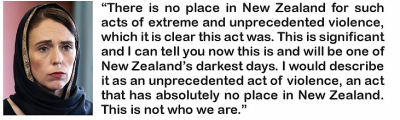
It is tragic footnote to this story that globally Muslims have been by far the most victimised group in the post 9/11 era. In a 2011 report, the US government’s National Counter Terrorism Center (NCTC), said: In case where the religious affiliation of the terrorism casualties could be determined, Muslims suffered between 82% and 97% of terrorism-related fatalities over the past five years.
But the way Friday’s attack in New Zealand has set the ball rolling on the discourse of right wing extremism has raised fundamental questions about safety and security in liberal democracies. It has also exposed the fact that how social media, populist politics and xenophobia has created a community of extremists like Christchurch massacre gunman. A section of western media, which until now has served as a vehicle for propaganda, misinformation and stereotypes, too will have to answer for the biased coverage.
Gun licences
One good take away from the Friday attack was that the many nations in the west have started to change their gun laws, as a preliminary step to check such attacks in future. New Zealand Prime Minister Jacinda Ardern also said that “our gun laws will change’’.
“There were five guns used by the primary perpetrator,” she said at a news conference in Wellington. “There were two semi-automatic weapons and two shotguns. The offender was in possession of a gun license. I’m advised this was acquired in November of 2017. A lever-action firearm was also found.”
She said the suspect, identified as Brenton Tarrant, obtained a gun license in November 2017 and began purchasing guns legally in December 2017.
“While work is being done as to the chain of events that lead to both the holding of this gun license and the possession of these weapons, I can tell you one thing right now. Our gun laws will change.” Ardern said.
Despite those laws, New Zealand’s weapons legislation is considered more relaxed than most Western countries outside of the USA. Gun owners do need a license but they aren’t required to register their guns — unlike in neighbouring Australia.
Bangladesh Team Called Off New Zealand Tour
Not only the worshippers in mosques, cricket too was the victim of terrorist attack in Christchurch. Bangladesh cricketers were “minutes” from being inside a mosque in which a fatal shooting took place. “Players and coaching staff were 50 yards from the Al Noor mosque in Christchurch, when the shooting began. If we were there five minutes earlier, it would have been worse” Bangladesh team manager Khaled Mashud told media after the attack. The Bangladesh cricket team was on tour in New Zealand for more than a month and was set to play the third and final Test in Christchurch, which was later cancelled.
The team was caught up in a mass shooting that happened during Friday prayers at a mosque near the Hagley Oval cricket ground.
ESPN Cricinfo reporter Mohammad Isam filmed members of the Bangladesh team hurrying away from the mosque through Hagley Park after the incident.
The team later called off their tour to the New Zealand.
The Australian women’s under 19 team was also in Christchurch at that time.
The remainder of their New Zealand tour was also cancelled and they will return to Australia.